


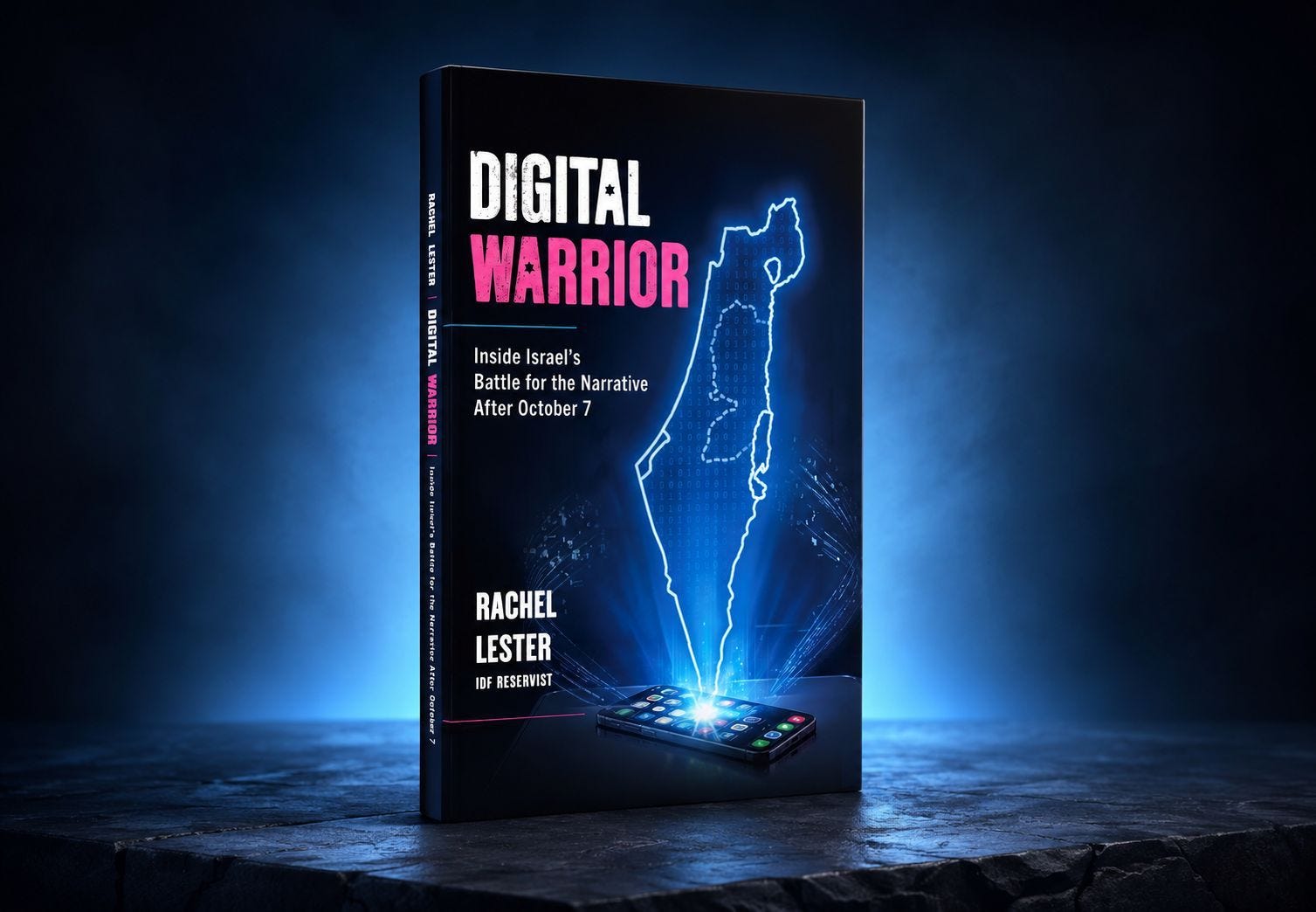
Israel isn't fighting one information war. It's fighting three. At least, that’s the takeaway I had when I read Digital Warrior: Inside Israel’s Battle for the Narrative After October 7 by Rachel Lester this week.
Rachel served in the International Branch of the IDF Spokesperson's Unit, first on active duty, then in reserves from October 8th, 2023, editing and shaping video content for accounts with over 10 million followers across platforms. You probably saw her videos from the official IDF X account, or from her personal Instagram, @Rachel.In.Reserves
Thinking back to the early days following the October 7 massacre, what struck me most was the impossible communications challenge the IDF faced. Her job, and the job of the army, was to explain multiple things to the world at once.
“I think that Israel faces social media challenges that no other army and no other country in the world face,” she told me. “I think that we have the unique challenge of trying to reassure our civilians that we are safe and that the army is in control, while at the same time conveying to the world these are our enemies, this is what our enemies are doing right now… this is what our enemies just did: committed the largest attack on Israel in our history. And if we don’t fight them, then they’re gonna do it again and again, as they’ve said.”
One country, three completely different messages
One of the central arguments in Digital Warrior is that the IDF isn't running one narrative. It’s running three, simultaneously, to three audiences - and the messages don’t just differ in tone, they actively contradict each other.
To the local, Hebrew-speaking audience - the message is reassurance: we are strong, we’re handling it, you don’t need to worry.
To the Arabic- and Farsi-speaking world - the message is closer to a warning: we are strong, we’re watching you, and your own leaders are the ones corrupting you.
And to the international, English-speaking audience, the posture flips entirely: we are at risk, we are under attack — because that’s the only framing that earns Israel the right to defend itself in the eyes of the world.
Project strength to one audience and vulnerability to another, at the same time, and you’d think it’d collapse under its own weight. Rachel told me it basically does, sometimes. The three departments work almost entirely independently of each other - there’s no room for someone to coordinate the tone across all three. “Sometimes it works, and sometimes it doesn’t,” she said.
The moment she paused
I considered the paradox Israel found itself in, and thought about why it didn’t apply to Hamas’ messaging strategy. So I put it to her directly: Didn’t Hamas actually pull off the version of this that Israel is still struggling with? A fear campaign aimed at the region, running alongside a sympathy campaign aimed at the West without the contradiction ever really catching up to them?
“That’s an interesting point I hadn’t considered before,” she said. Western outlets, she pointed out, never really broadcast the moments when Hamas spokespeople promised “to do October 7th again and again.” That footage exists, as Rachel saw firsthand, but it just doesn’t travel the way photos of dead children (or P.O.D.C., a term she coined for the book) do.
As the war dragged on, Hamas’ messaging was contained inside its Arabic-language threats, but its English-language grief campaign spread across the world. Somehow, the two rarely collided in the same feed, in front of the same audience, at the same time. This was not true for Israel, whose messaging sometimes came out slowly or inconsistently - and whose critics were quick to highlight these contradictions.
This is more than a media-strategy story
It would be easy to file this under another “PR problem” Israel has to overcome, and move on. But I don’t think that’s what it is. Our conversation kept circling back to how, in a war where legitimacy determines whether you’re even allowed to keep fighting, the coherence of your story and its narrative matters as much as the truth of it.
That challenge is only becoming harder now that AI makes it easier to manipulate and dismiss authentic content. During our conversation, we discussed the “liar's dividend”, a term coined by legal scholars Bobby Chesney and Danielle Citron for exactly this phenomenon: real evidence getting waved away simply because fake evidence is now possible.
She mentioned an instance in 2023 when journalists doubted the validity of footage released by the IDF. And earlier this year, genuine footage of Netanyahu was mistaken online for an AI fabrication. So the tech doesn't even need to be actively used against Israel. Its existence alone is often enough to doubt or undermine its digital efforts.
That’s the tension I’d encourage you to sit with if you pick up Digital Warrior: not “is Israel’s PR bad,” which is the question everyone already has an opinion on, but “can any democracy actually hold three contradictory messages together in an age when information is everywhere?”
Digital Warrior is out now. You can follow Rachel on Instagram here.
For transparency: I have no financial relationship with this book or its sale. This recommendation is unpaid.


