


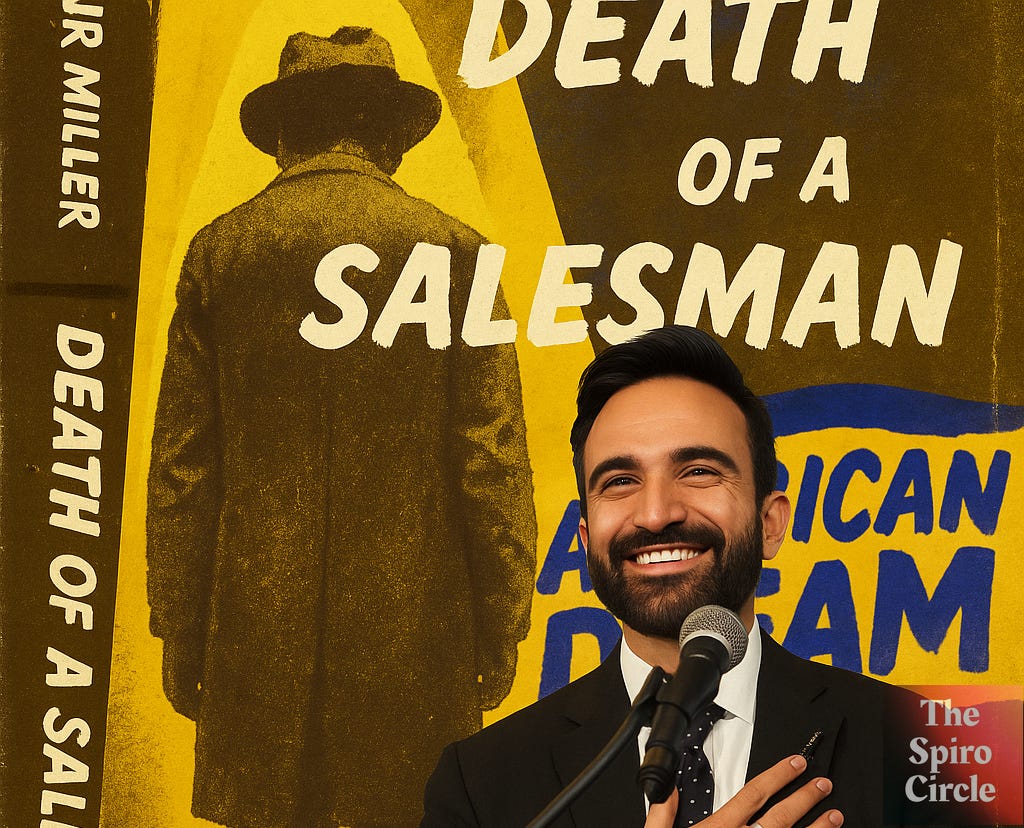
The American Dream ended this year. Or it was reclaimed. Or it never really existed at all. After the shocking (but not surprising) win for New York’s progressive and Democratic Socialist mayor-elect, Zohran Mamdani, emotions run high. Say what you want about his ideas or track record to govern effectively, his victory taps into the hopes and failures of the country’s greatest promise: that hard work and likability inevitably lead to reward.
We’ve been warned about the precarious nature of the American Dream before, famously in Arthur Miller’s 1949 Death of a Salesman. Taking place in Brooklyn nearly a century before Mamdani would rock onto our social media timelines, Willy Loman was chasing his own dream up and down the highway - to tragic results.
Willy isn’t just obsessed with success; he is haunted by it. The promise by his country that grit and personality would push him over the finish line and overcome the structural limitations of “the system” drove his lifelong motivation. He ultimately fails, becomes disillusioned, and sees his only worth left in the form of a used insurance policy. In the end, his suicide is more economically valuable than his life. The play inverts what the American Dream is to those who chase it and paints a portrayal of a man whose own culture has betrayed him, leading to loneliness, delusion, and death.
To many young people today, Mamdani’s win comes out of the ashes of those same betrayals and broken promises. His campaign, when focused, honed in on housing costs, inequality, and the illusion that the city works for everyone. Whereas Willy clings to a system that exploits him, Mamdani challenges it outright. His appeal is among the disenfranchised who believe their hopes in the city are unattainable and upward mobility is no longer part of their story. To them, the antidote is another form of disillusionment: utopia.
Both the salesman and the socialist represent a distorted version of the American Dream that no longer belongs to them: one who fails to capture it, and the other attempting to rescue it from cynicism while actively benefiting from it.
And then there’s the question of where we are all expected to fit into this new Dream. In his acceptance speech from November, Mamdani made a point to speak to “Yemeni bodega owners and Mexican abuelas. Senegalese taxi drivers and Uzbek nurses…” Not a melting pot, but a patchwork. And in that patchwork was a missing piece: The Jewish people.
How fitting then, in these delusions of the American Dream, that Jews once again feel exploited and invisible - just like Willy when he sees the world change from under him. Mamdani’s record of anti-Israel statements and filling his staff with those who carry sympathies with Hamas-linked groups has raised tensions in certain communities, leaving Jews feeling isolated and left behind within an old-fashioned system that the mayor intends to destroy.
The Jewish people were on the same boat staring at Lady Liberty when they escaped persecution from Europe before they had the safety of the State of Israel. Today, their next mayor vilifies their only true haven. Despite the billions of dollars and thousands of jobs brought to New York by Israelis, this incoming Mamdanism finds Jews sitting at Shabbat this weekend in Brooklyn (and beyond) asking the same questions posed to the Loman family 80 years earlier: What happens when the world you know moves on without you?
What a 'Mayor Mamdani' would mean for New York’s Israeli tech economy
·At the time of writing, it is a safe bet to assume that self-proclaimed ‘Democratic Socialist’ Zohran Mamdani will be elected Mayor of New York City. Early voting is already underway, and betting site Kalshi has him at a 92% chance of winning.

Ultimately, Miller’s masterpiece and Mamdani’s mandate are two chapters of the same American story: one chasing a path, and the other driving toward success. Death of a Salesman showed us how the American Dream collapsed under its own weight, and last month’s election showed us that, despite disillusionment, the Dream is also very much alive - albeit rewritten for a new generation with new hopes, fears, and different meanings of ambition.
Whether it becomes another tragedy or a time of renewal will depend, as it always does, on whether we can learn to believe without lying to ourselves.