


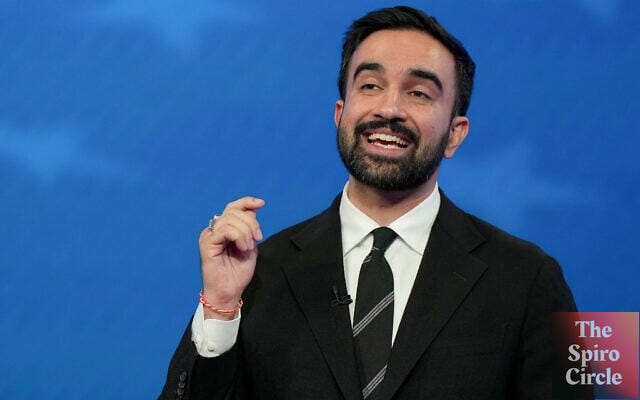
At the time of writing, it is a safe bet to assume that self-proclaimed ‘Democratic Socialist’ Zohran Mamdani will be elected Mayor of New York City. Early voting is already underway, and betting site Kalshi has him at a 92% chance of winning.
Not a sure-fire win, as history has shown, yet we can all but assume he will cross that finish line. And so New York will soon have a mayor who refuses to say whether Hamas should disarm. Its mayor will be closely affiliated with Students for Justice in Palestine (SJP), an organization that called October 7 a “historic win for the Palestinian resistance”. Its mayor will not support Israel’s right to exist as a homeland for the Jewish people.
So when he does win, which is looking all but inevitable, he will have to contend with a loud and large tech sector comprised of hundreds of companies founded by Israelis who bring in billions of dollars to the New York economy. As I recently wrote in CTech:
The Big Apple is home to 590 Israeli-founded companies, which supported 50,648 total city jobs and generated $8.1 billion in total earnings.
In 2024, they contributed $12.4 billion in value added to the city’s economy and generated $17.9 billion in gross economic output. In total, the city serves as the global or U.S. headquarters for 20 Israeli-founded unicorns – privately-held companies with a valuation of at least $1 billion, such as BigID ($1.2 billion), Fireblocks ($8 billion), and Wiz.
The number of unicorns in New York has risen to 20 from five in 2019, only one year after Mamdani himself became naturalized in the United States.
Israel, and its citizens, have created tens of thousands of jobs for New Yorkers and given the state billions of dollars. Founders of these billion-dollar companies will soon have grown up in a country their mayor refuses to acknowledge, with the exception given only to offer condemnation and relentlessly accuse of genocide.
It’s a profound act of ingratitude, and a dangerous form of ignorance, toward a community that has given so much to the city he now expects to lead. I ask, therefore, what exactly has Mamdani himself accomplished other than earn office on the promises of free transport, frozen rents, and skin-based taxation? Not much.
It is on-brand for socialists or progressives to focus on the redistribution or restriction of wealth rather than increasing efforts to promote or create it. The focus on ‘taxing the rich’ while simultaneously condemning those who generate that wealth will cause an exodus from the city, unlike anything it has seen since the pandemic.
I would know. I’ve seen for myself in my hometown of the UK what these kinds of proposals can do. The country led by its Labour government is “expected to suffer the largest outflow of millionaires globally in 2025, according to data from Henley & Partners, marking a bleak reversal for a country once seen as a magnet for global wealth.”
These Israeli companies that chose New York as their US-based home should reconsider if the Empire State is the right place to call home. In my years-long research on why Israeli companies choose New York for their American headquarters, reasons varied from direct flights and convenient time zones to budding promises of talent and adventure. With a Mayor Mamdani, those appeals will soon drain away to neighboring states with more attractive and friendly incentives.
Therefore, it would make sense for Israelis to use this economic strength on the city to exercise some leverage: fight to counter antisemitic attacks on its people in the streets; foster a more Israel-friendly environment on the city level, and lobby for greater collaboration between two hubs of Jewish and Israeli talent.
It was only last year that I stood a few feet away from Mayor Eric Adams, who spoke on stage and called New York “the Tel Aviv of America”. It was a meaningful acknowledgment of the Jewish people in his city at a conference that was delayed because of October 7.
Israelis in New York once had the support of their mayor. But a Mayor Mamdani would need to recognize that his city’s success is built, in part, by those from a country he vilifies. And Israelis mustn’t be afraid to fight to remind him through advocacy, visibility, and economic pressure if necessary.