


Washington does not often play the long game publicly. Terrorism designations tend to follow attacks, plots, or intelligence disclosures - moments of urgency that demand swift response. The decision to designate three branches of the Muslim Brotherhood as terrorist organizations, however, signals a reassessment of how ideological movements outlast methods, regimes, and even generations.
And President Trump intends to leave his mark on history.
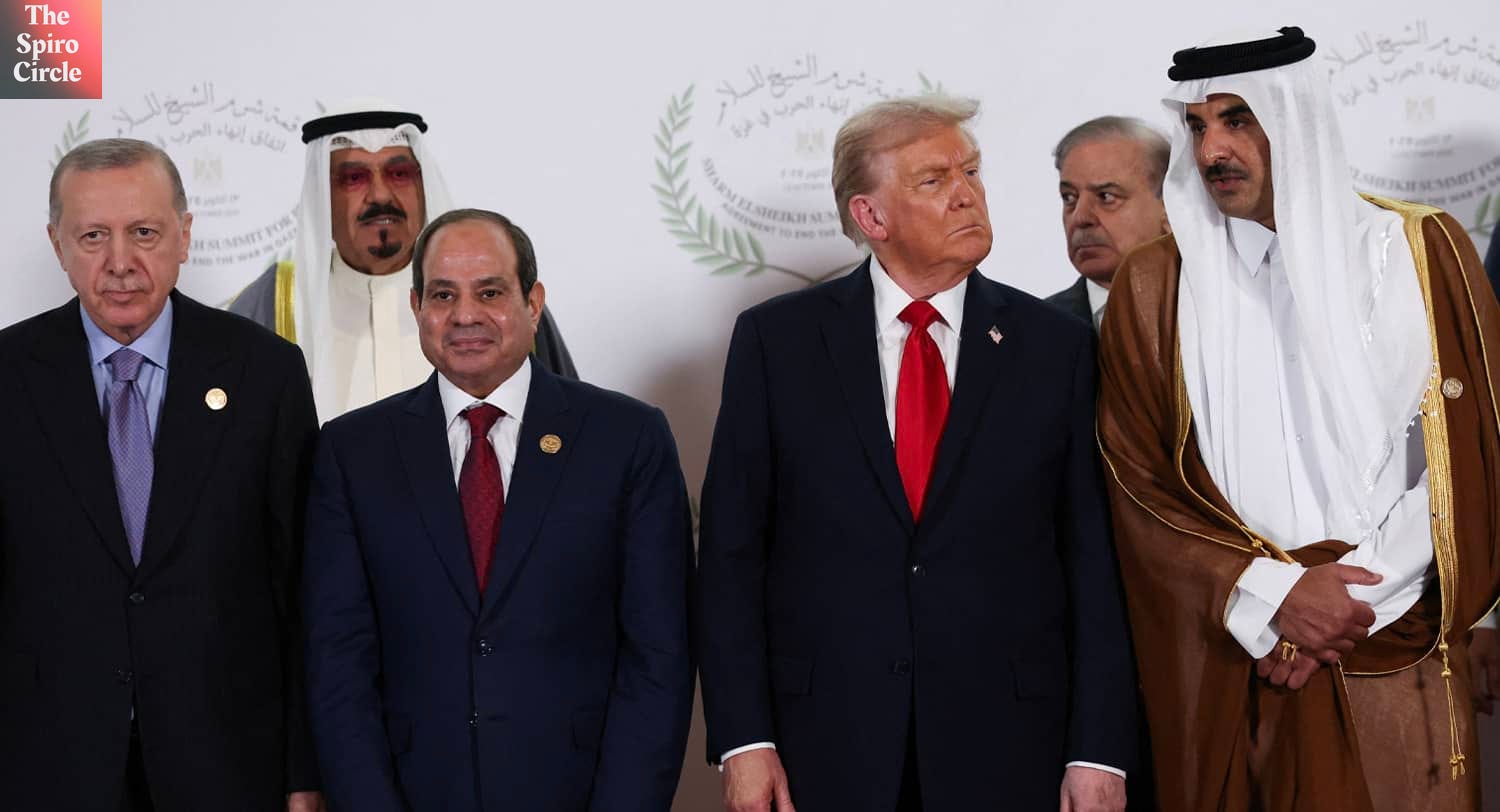
Under his direction, the U.S. State Department designated the Lebanese branch of the Muslim Brotherhood as a Foreign Terrorist Organization, while labeling the Jordanian and Egyptian branches Specially Designated Global Terrorists for their support of groups including Hamas.
The move follows a December executive order directing the State and Treasury Departments to examine whether these branches met the threshold for designation. It turns out, at long last, they did.
The Muslim Brotherhood has long resisted clean categorization. Founded in Egypt in 1928, it functions less as a centralized organization than an ideological ecosystem: something that adapts to what is needed in that time of history within national contexts, political constraints, and cultural norms. Some Brotherhood-linked groups have participated in elections and civic life. Others have operated underground. Still others have been accused of facilitating or legitimizing violence without carrying it out directly.
For decades, that ambiguity shaped Western engagement. The Brotherhood was often viewed as a political actor that could be moderated through participation, even if its worldview sat uneasily alongside liberal democratic norms. That assumption has steadily eroded.
“This is not simply about violent activity,” said Dr. Charles Asher Small, executive director of the Institute for the Study of Global Antisemitism and Policy (ISGAP), which has briefed U.S. officials on the Brotherhood’s global operations. “It’s about a movement that works from within open societies to reshape them.”
ISGAP’s critique centers on what it calls the Brotherhood’s strategy of “strategic entryism”: embedding itself in civic institutions, advocacy organizations, and religious networks to influence culture and policy over time. In November, the group published a report documenting how such strategies have played out in Western democracies, framing the Brotherhood less as a transient threat than as a patient one.
That framing increasingly aligns with how policymakers are thinking about extremism in a post–October 7 world.
Hamas’s attack on Israel and its origins in the Brotherhood’s ideological tradition forced a reckoning with the infrastructure that sustains militant groups beyond the battlefield. The branches named in this week’s action were not designated for launching attacks, but for enabling the political, financial, and ideological ecosystems that allow groups like Hamas to endure.
In that sense, the U.S. move resembles its evolving posture toward other long-horizon challenges. Iran’s regional strategy, for example, relies less on direct confrontation than on cultivating proxies, institutions, and narratives that persist even when leaders change. Venezuela’s authoritarian durability similarly reflects the capture of systems rather than the use of overt force alone. In each case, power is exercised through endurance.
The Muslim Brotherhood operates on a comparable timeline.
Impact on the Region
Regionally, the designation also places Washington closer to the positions long held by several Gulf states. Saudi Arabia and the United Arab Emirates have designated the Brotherhood as a terrorist organization, viewing it as a threat to state cohesion and political legitimacy. European governments, while more cautious, have intensified scrutiny of Brotherhood-linked institutions, particularly around radicalization and antisemitism.
The United States has historically been more restrained, in part because of constitutional protections and in part because Brotherhood-affiliated groups often operate in the gray zone between religious life and so-called political activism. That restraint is now being recalibrated.
There are clear risks. Jordan remains a critical U.S. ally, and its Brotherhood-linked political wing has participated in parliamentary politics for years. Critics argue that terrorism designations risk flattening distinctions between political opposition and extremism, potentially complicating diplomacy and domestic civil liberties debates.
Supporters counter that the distinction has already been exploited.
The challenge, they argue, is no longer how to respond to attacks, but how to confront movements whose primary weapon is by inhabiting systems until they bend, rather than overthrowing them outright.
What follows will determine whether this week’s move marks a turning point or a symbolic gesture. Treasury officials will now begin identifying affiliated individuals and financial networks. Lawmakers will debate whether the approach should expand to other Brotherhood-linked entities. And Muslim communities, in the U.S. and abroad, will scrutinize how narrowly (or broadly) the policy is applied.
President Trump is indeed preparing for a long game. And for the first time in years, the United States is signaling it intends to play it long after he is gone.