


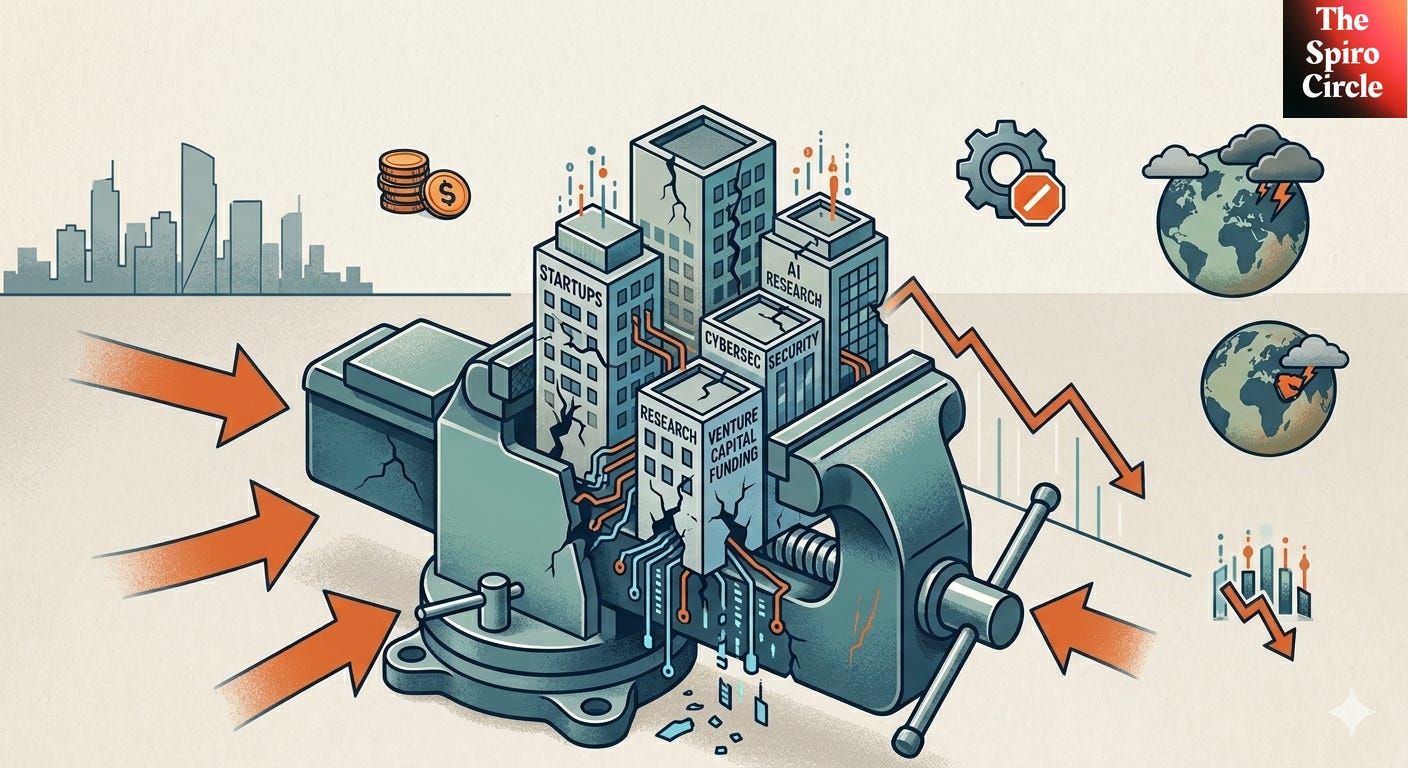
Four weeks into Operation Roaring Lion, the Israel Innovation Authority has surveyed 637 executives to find out what the war is actually doing to Startup Nation.
The numbers aren’t pretty, but they’re not surprising either.
The most urgent finding is what’s happening to capital. 71% of companies say the security situation has disrupted their investment processes. Of those, 37% are facing delays, 23% have had investors stall or postpone decisions, and 11% have already canceled their fundraising processes entirely.
For a startup that is months away from closing a round, that last figure could potentially mean the end of the company’s life.
The Damage Isn’t Even
The financial impact isn’t evenly spread across the country. Companies in Israel’s north and south are canceling fundraising at roughly double the rate of those in Tel Aviv and the center: 18% versus 8–10%.
Even though the center may feel as though it is the target of larger physical attacks from Iran and its proxies, it’s a reminder that the war doesn’t look the same from a startup in the Galilee as it does from a WeWork in Sarona. Smaller companies are bearing a disproportionate share of the economic pressure: roughly 12–13% of firms with fewer than 50 employees have abandoned capital raising altogether.
This is happening against an already difficult funding backdrop. Israeli startups raised $15.6 billion in 2025, but the number of deals fell to just 717 (the lowest in a decade), with half of all capital concentrated in rounds above $100 million.
This means that the money is here, but it’s flowing toward the big and the established. For everyone else, Operation Roaring Lion is closing a door that was already narrowing.
Small Companies, Outsized Risk
Then there’s the question of whether some companies survive this at all. 12% of respondents say that if the security situation continues for another month, their company may close. Startups with fewer than 10 employees represent the majority of companies in Israel’s ecosystem, and among those, that figure climbs to 17% - with an additional 40% expecting to downsize or delay projects.
It doesn’t take long for development to slip. 87% of companies report some delay in meeting product or launch milestones, with 42% calling those delays significant. Meanwhile, nearly half (48%) of all companies say that more than a quarter of their workforce is currently absent: pulled away by reserve duty, security restrictions, or a childcare system that has largely stopped functioning.
Considering the Exit
And if the war keeps going, 31% say they’ve considered relocating operations overseas. Of those weighing relocation, 80% are internationally oriented companies, the exact companies whose global reach and foreign-currency revenues the broader economy depends on most.
If that sentiment turns into action, the consequences would extend beyond Startup Nation and into the broader economy.
“Israeli high-tech continues to demonstrate its resilience and its ability to operate even under challenging conditions,” said Dror Bin, CEO of the Israel Innovation Authority, acknowledging the strain while framing it in the context of the sector’s track record. “Experience from recent years shows that the sector has proven its ability to recover quickly. The current challenge is to enable companies to navigate this period and return to a growth trajectory once the conflict subsides.”
The recovery from Iron Swords was indeed faster and stronger than many expected, and Bin said the Authority is currently analyzing all survey responses and examining potential support mechanisms. “Should the security situation continue, the Israel Innovation Authority will act to formulate measures... to ensure the sector’s stability and its ability to continue growing and leading on the global stage,” he added.
The sector has proven it can absorb a shock like October 7. But as this new war appears to evolve into the next and newest ongoing conflict, it now depends on whether it can absorb a grind.