


New research from the Hebrew University of Jerusalem puts a name to some of the behavioural changes associated with collective trauma. The idea is that damage is caused far beyond the emotional, and rewires our immediate impulses in ways we may not even notice.
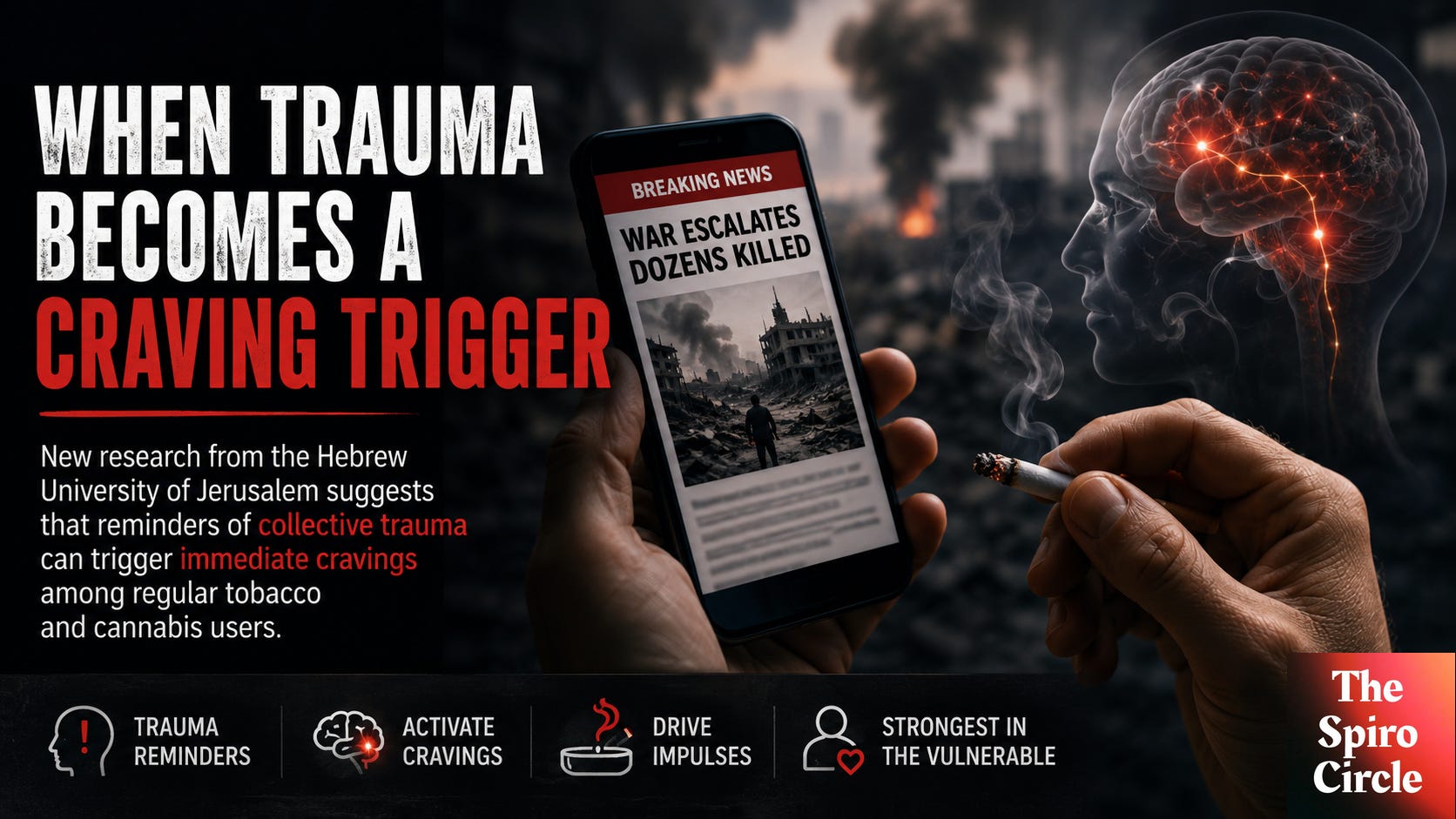
The study, published in the Journal of Health Psychology and led by researchers at Hebrew University and the Israel Center for Addiction and Mental Health, found that simply reading about the October 7 attacks caused a measurable, immediate spike in cravings for tobacco and cannabis among regular users. The mere exposure to a photographic news article was enough to trigger an immediate increase in self-reported cravings.
The researchers frame this through terror management theory, a psychological framework built around a distinctly human problem: the understanding of our own mortality and our fear of it. When confronted with reminders of death and existential vulnerability, the mind deploys rapid defenses to suppress that awareness before it becomes paralyzing.
For many people, the urge to smoke is one of those defenses. It acts as almost an automatic “psychological shield” that temporarily pushes thoughts of death out of conscious awareness.
Two experiments were conducted. In the first, moderate-to-high-risk cannabis users were asked to read an account of the October 7 attack alongside recognisable images. A control group read an article about dental pain. The trauma-exposed group reported significantly elevated cravings. The second experiment replicated the methodology with daily tobacco smokers and found the same pattern. The effect was consistent, replicable, and immediate.
The strongest craving responses were observed among participants with high attachment anxiety. This is defined as those who harbour deep worries about their own lovability and whether their support networks will actually show up for them. Overall, these people reported consistently higher cravings across the board.
In summary, the people least secure in their relationships, least confident that they are loved and supported, are the ones most likely to reach for a cigarette when they feel like the world is ending.
What’s also noteworthy is what didn’t help: High self-esteem, strong national identity, secure attachment, and self-affirmation exercises were ineffective as traditional psychological buffers to reduce the craving spike triggered by the trauma reminders.
This Is Not Just Israel’s Story
In an era of algorithmically-delivered doomscrolling where war, polarisation, and terrorism are fed directly into our pockets, we are all being dosed with collective trauma on a near-daily basis. This means that for many, the news isn’t just information anymore. For millions of people, especially the young, it is a craving trigger.
The broader data makes the picture darker. National surveys from the Israel Center for Addiction and Mental Health (ICAMH) tracking the period from April 2022 to February 2025 found that over 15% of Israeli adults now present problematic use of at least one substance or addictive behaviour, with researchers warning of a long-term normalisation of high anxiety, PTSD, and substance abuse. A separate NATAL analysis found a 25% increase in addictive substance use among those directly exposed to the October 7 attacks, with the rate of dual diagnosis of PTSD and substance use disorder among military veterans reaching between 50 and 76%.
Israel’s state comptroller concluded in a February 2025 report that the mental health system had effectively collapsed in the first days of the war, with the annual funding shortfall estimated at between 3-4.5 billion shekels ($1.06 billion to $1.6 billion). The infrastructure to treat what is happening was already overwhelmed before most of the research had been published.
What’s most interesting from the study is how it shifts discourse around trauma from chronic mental health outcomes (PTSD rates, depression scores, long-term addiction trajectories) to the more immediate, moment-to-moment mechanics of how trauma actually travels. It shows that a news cycle can be a pharmacological event. That reading the morning headlines or remaining up to date with the news can be neurologically indistinguishable from a traditional craving trigger.
