

This week I am publishing a guest post written by Eitan Goldstein, a Middle Eastern expert and personal friend who has been an incredible source of Israel-related news over the war. He is one of the most insightful people I know in the space and am pleased to share his work with you.
You can learn more about Eitan at the bottom of this email, but for now, here is his LinkedIn. Enjoy.
- JS
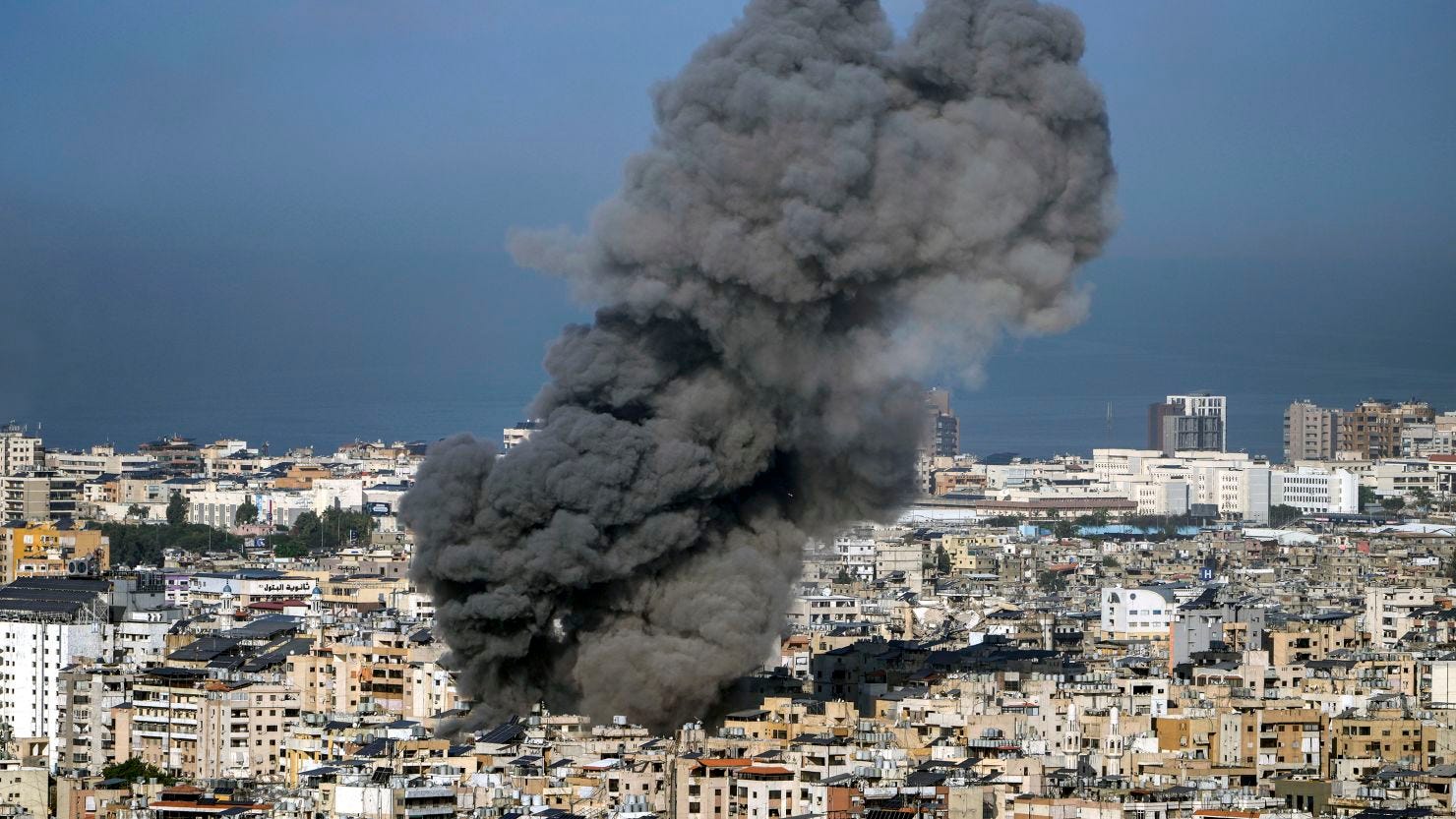
The View from Lebanon
Hezbollah has been shooting rockets into Israel for over a year, causing Israel to move into southern Lebanon to take care of the threat. While many people have seen the effects of this in the media - women crying, destroyed buildings, and displaced people roaming the streets of the capital - few understand the shifts this war is causing to Lebanese society. These shifts are mainly spoken about in whispers, but which has the potential to change the Middle East.
Before the War
It’s important to understand how Lebanon functioned before the war. Basically, it didn’t.
Lebanon is a country with dozens of different religious sects (Maronites, Greek Orthodox, Druze, Sunni Muslims, Shia Muslims, etc.) that went through a 15-year civil war ending in 1990. These sects, each with their own militias, formed a government. However, while the armed wings either ceased or reduced operations, the militia leaders became the government’s ministers, going on to control the country’s assets and services.
For instance, one sect gained control of the water supply, one took over the power supply, one took over garbage collection, etc. Hezbollah gained control of Lebanon’s land crossings, its only seaport, and the airport - critical infrastructure for a country that imports approximately 85% of its goods.
Then, in 2019, Lebanon as a country began to collapse due to all the sects using their control over their various public sectors as piggy banks, funneling the money to people in their ethno-religious group. To top it all off, 2020 saw an ammonium nitrate explosion destroy the Port of Beirut, with Hezbollah and its allies preventing any investigation into its causes.
Lebanon’s general collapse saw the strongest and most organized force in the country, Hezbollah, step in to fill the gaps. With the national grid only providing about 4 hours of electricity per day, Hezbollah created a monopoly on the fuel that runs private generators. As inflation caused food prices to skyrocket, Hezbollah provided its people and allies with subsidized supermarkets. And with the collapse of the healthcare system, Hezbollah provided care to the Shias and their allies in brightly lit medical centers.
The War Begins
Hezbollah began attacking northern Israel on October 8th, 2023, one day after the atrocities committed by Hamas in the south.
While many Lebanese sympathize with the Palestinians, they didn’t want to see their own country dragged into a war with Israel, remembering how the country was devastated back in the Second Lebanon War in 2006. But still, they didn’t publicly protest Hezbollah’s actions.
However, as time dragged on and Hezbollah gave no indication it would stop attacking Israel, the Jewish State caused several thousand Hezbollah pagers to explode, assassinated Hezbollah leader Hassan Nasrallah, and launched a war to destroy the terror group’s infrastructure in south Lebanon. This ultimately caused hundreds of thousands of Lebanese Shia to flee north to the rest of the country.
A Cool Welcome
Hezbollah’s grip on Lebanon began to unravel as Israel began its ground invasion, with Israel destroying Hezbollah’s military capabilities in the south of the country - mostly located inside and underneath civilian infrastructure. The fleeing civilians expected a warm welcome in places such as Beirut, Tripoli, and Baalbek. After all, they were the ones who were defending Lebanon from the Zionists. Yet that wasn’t the case.
People are refusing to rent apartments to these Southerners. Landlords are concerned that the men of these Shia families include Hezbollah commanders, and are concerned that Israel will target the apartments in airstrikes. Israel has been hitting Hezbollah-controlled banks, safe houses, and storage facilities in and around all of Lebanon’s major cities, and Lebanese non-Shia citizens are worried about being turned into collateral damage should they allow the Shia into their homes.
There are even reports that entire villages and towns are refusing entry to Shia from the south worried there might be Hezbollah commanders hidden among them and terrified of an Israeli attack. They are also angry at the way Hezbollah treated them and their country over the years.
To top it all off, Lebanese Shia are also more conservative than their compatriots. People in liberal areas such as Beirut are becoming increasingly uncomfortable walking around their own cities, especially those who are atheists or secular.
The Way Forward
Hezbollah has been weakened. Its command structure has collapsed and it’s losing ground to Israeli forces. The terror group is now just marginally more powerful than the other Christian, Druze, and Sunni militias inside of Lebanon.
This gives the actual Lebanese government the opportunity to regroup and retake control of the country. There’s also a possibility of having the Arab Gulf States, western European countries, and the US create a comprehensive plan to rebuild Lebanon from the ground up now that Hezbollah is no longer holding the country hostage.
It should be noted that the Lebanese people have been brought up to hate Israel and view the Jewish State as their mortal enemy for the past 75 years. Undoing generations of brainwashing will take generations. Lebanon might be forced into a cold peace with Israel by the Gulf States and the West, yet unless the Lebanese education system is changed, the population will continue to despise Israel.
However, with Hezbollah out of commission, the possibility for a strong, thriving, and successful Lebanon has never been greater.
Eitan Goldstein is a Middle East expert who served as a policy NCO in the Foreign Relations division of the IDF. He was also a senior editor at Ynetnews, the English-language edition of Israel’s largest newspaper. He currently works in public relations where he promotes Israeli organizations in the international press. He is fluent in English, Hebrew, and Arabic.