


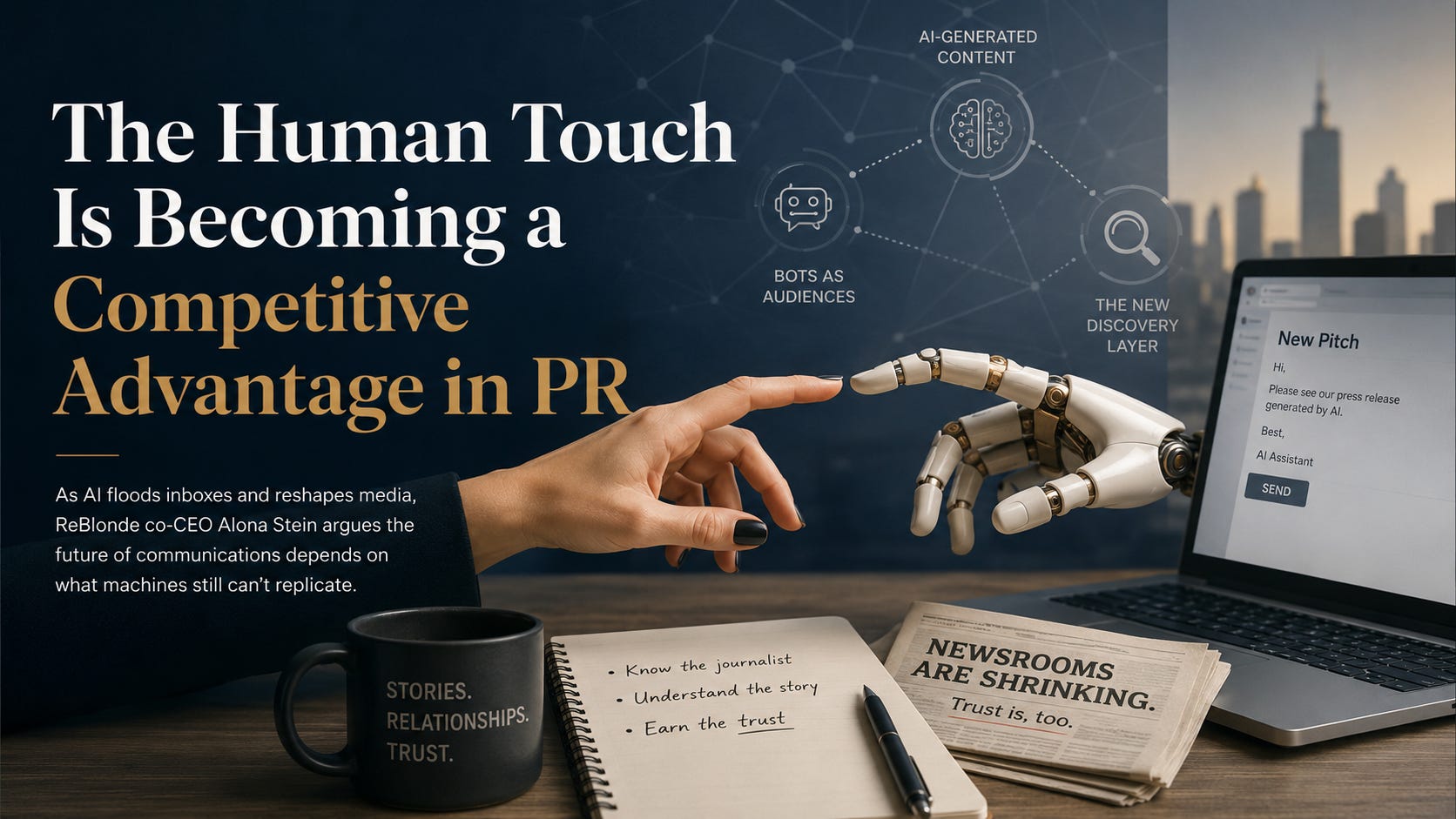
AI has arrived in the communications industry the way it’s arrived everywhere else, and every agency has an opinion on it. Most of those opinions are defensive. And somewhere between the consultants who insist AI will never replace human storytelling, and the founders who run their entire content operation through Claude, there’s a conversation to be had about what’s actually happening.
Alona Stein has been in tech PR for 13 years. She’s co-CEO of ReBlonde, a Tel Aviv-based agency that has worked with everyone from Spotify to early-stage startups with two founders and a pitch deck. She’s seen cycles like crypto, NFTs, the pandemic, wartime operations, and funding winters, and can spot the difference between a gimmick and a structural shift in the industry.
We spoke about storytelling in wartime, finding founder stories, and, of course, the impact of AI on the media space.
“AI is bad news across the industry,” she told me. “It has the potential to change life for the best. The problem is the misuse… trying to replace things that are not yet ready to be replaced, or may not be able to be replaced at all.”
What she’s talking about specifically is content, and the loss of the “human touch,” which is so important for work like hers. Sending a personal pitch or writing a tailored press release are some of the things that public relations runs on.

“Even now, where AI is a lot sharper than it was three years ago, it is still incapable of writing a story like a journalist,” she said. “And I think you know that, and I know that, and a lot of our friends in the media know that. But somehow the media houses, or the person sitting with the money… they’re going to miss the mark.”
The result is a media landscape that is shrinking both in quality and volume. Fewer journalists, less trust in outlets, and generally more noise. And PR agencies are caught in the middle, competing for an ever-smaller number of slots with reporters who are covering more ground than ever before.
“Already you’re in a position where you have to really sharpen your skills and your stories,” Stein added. “And that’s even before we’re talking about pandemics and AI and wars.”
Here’s where I’ll admit my own bias. For those who don’t know, I’ve been on both sides of the pitch - as the journalist receiving it, and before that, the PR person crafting it. The pitch, at its best, is a sign of a strong relationship. It tells the person you’re contacting that you read their work, understand the beat, and think it’s worth their time. Today I am receiving AI-generated pitches, which say none of those things. And I notice it immediately: The subject lines, structure, and cadence all share the same formula.
And these relationships are where human touch can far outrank AI.

“We would never write a press release with AI. We would never send an AI-driven pitch to the media. I’m speaking to a person. The person expects me, especially if we have this long-lasting relationship, to tell them where I think the story is.”
The agencies that cut those corners will actively burn the infrastructure that makes their job possible: the relationships, the credibility, the basic signal that there’s a human being on the other end who has done the work.
But that’s not the only place where AI will affect the PR industry. Because Alona also understands what’s next.
