


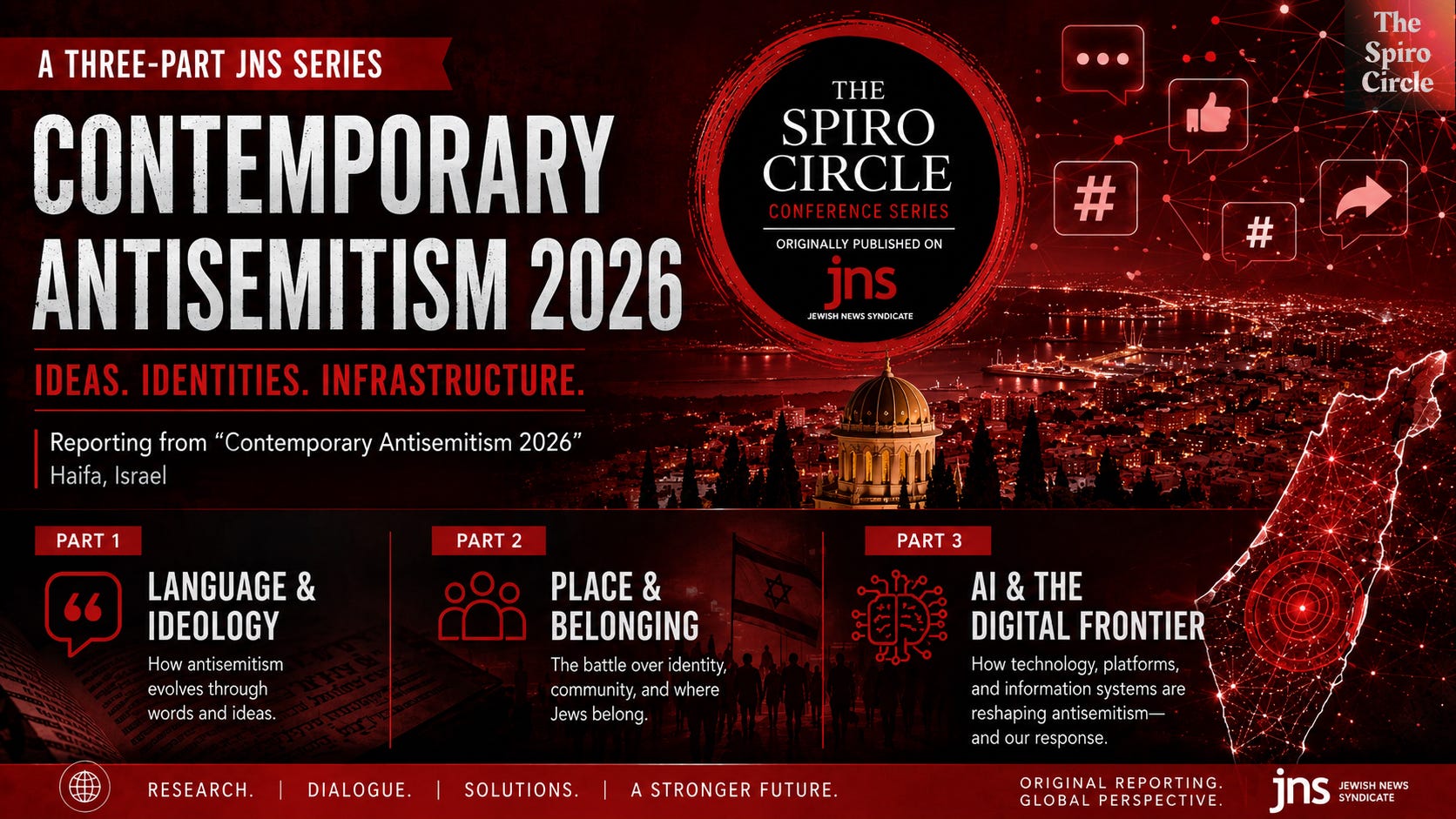
This week, I was in Haifa reporting for JNS on “Contemporary Antisemitism 2026”, a three-day conference dedicated to exploring some of the ways that anti-Jewish and anti-Israel sentiment is changing in modern times.
The event was overwhelming in all the best ways: Each day featured multiple simultaneous sessions, with each session including multiple lectures from academics, researchers, policymakers, and thinkers. It was simply impossible to hear it all, but some highlights included:
An exclusive sitdown with former Soviet refusenik and human rights activist Natan Sharansky, who today serves as chairman of the Institute for the Study of Global Antisemitism and Policy (ISGAP)
A Keynote speech by Deborah Lipstadt, distinguished university professor at Emory University, who served from 2022 to 2025 as the U.S. Special Envoy to Monitor and Combat Antisemitism
An address by French philosopher, author, and public intellectual Bernard-Henri Lévy, whose work has focused on totalitarianism, antisemitism, and Jewish identity
Part of my coverage agreement was to produce three daily wrap-ups for JNS that would attempt to convey the sheer scope and scale of everything that was discussed among the 330 speakers to the 500 attendees.
It was an impossible assignment. So rather than summarize dozens of panels each day, I decided to organize my reporting around three themes that kept resurfacing throughout the conference.
Below is a three-part series I wrote for JNS that tackles the conference and its themes in the following structure:
How antisemitism is defined through language and ideology
Where Jews belong in physical or digital spaces
How antisemitism spreads in technology and information systems
You are invited to read all three, in no particular order, from the links below. The pieces were designed to be read in isolation from each other while telling an overall story of where Jewish and Israeli people are fighting the battle of antisemitism in today’s world.
Topics include LLM algorithms, social media and digital knowledge systems, popular culture and minority movements, and how language can influence how cultures identify, understand, and confront anti-Jewish and anti-Israel sentiment.
Read Part One: At Haifa conference, scholars warn antisemitism is evolving through language and ideology
Researchers, academics, and writers gathered in Haifa on Tuesday for the opening of a three-day conference examining the impact of rising antisemitism across Europe and the United States. The event was delayed from earlier in the year due to the war, but it took place with hundreds of participants joining from more than 20 countries.
One of the most important themes presented was the power of language and how definitions can shape public discourse and influence new forms of antisemitism to emerge. It was a sobering reminder among many of the attendees, who themselves come from academia, that they need to address institutional antisemitism in educational and policy circles.
Read the whole piece here:
Read Part Two: Modern antisemitism has become a battle over belonging, scholars say
The second day of “Contemporary Antisemitism 2026” asked a different question than the first. Rather than focusing on language and definitions, speakers examined the spaces where Jewish identity is increasingly contested: on television screens, social media feeds, university campuses, intellectual frameworks and even within minority communities that once promoted solidarity with other groups.
Scholars repeatedly returned to a common theme: Modern antisemitism is increasingly expressed through questions of belonging. The issue goes beyond what people say about Jews online to where Jews are accepted, excluded, or expected to justify their presence.
Read the whole piece here:
Read Part Three: Antisemitism has entered the age of AI, researchers say
From AI and social media to Wikipedia and legacy newsrooms, the final day of “Contemporary Antisemitism 2026” turned to a new frontier in the fight against antisemitism: the digital systems that increasingly shape what people see, believe and what machines learn.
Across multiple sessions dedicated to AI, law, education and quantitative research, speakers described technology as neither inherently dangerous nor inherently beneficial, but rather as a force multiplier for both antisemitic narratives and efforts to analyze, expose and counter them.
Read the whole piece here:
The conference also marked the launch of the Contemporary Antisemitism Studies Association (CASA), a new academic organization dedicated to advancing interdisciplinary research on contemporary antisemitism.
If you are unfamiliar with my reporting at JNS, you are invited to read more of my work in which I discuss technology, finance, geopolitics, and more.